Leading Agentic AI: From Automation Projects To Agency Organizations
Agentic AI is not just another tool rollout. Leaders need to redesign organization, trust, and culture so agents can act responsibly.
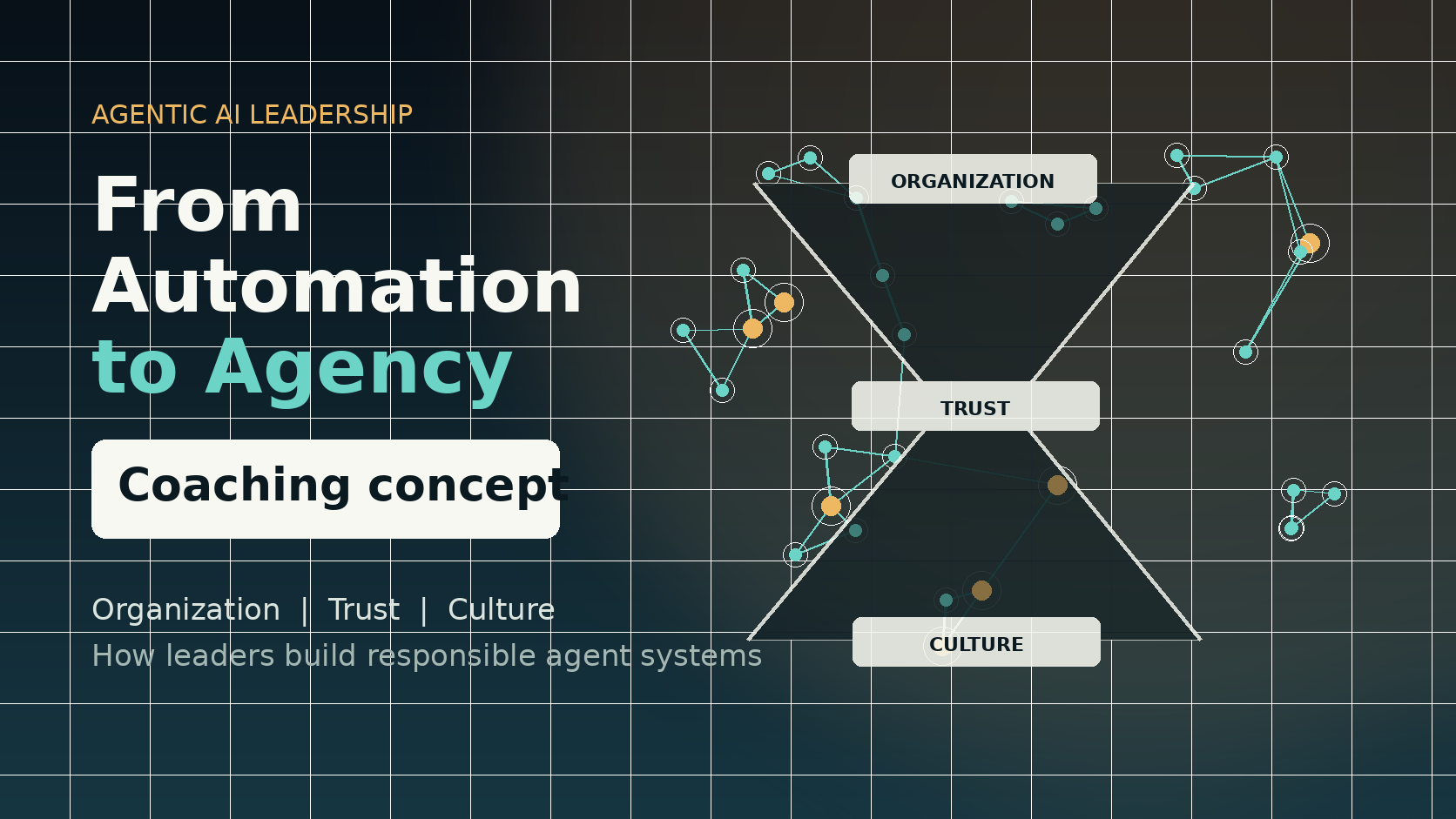
In his AWS talk "A Leader's Guide to Agentic AI: From Automation to Agency", Ishit Vachhrajani frames agentic AI not as another productivity wave, but as a leadership problem.
That distinction matters.
Many companies still treat agents as better automation: find a process, add AI, measure saved time, hope for scale. Agentic AI changes more than the speed of individual tasks. It changes who or what pursues goals, prepares decisions, uses tools, and triggers escalations.
So the core question shifts.
Not: Which task can AI take over?
But: What kind of organization can work with non-deterministic actors without losing control, learning, and accountability?
Intelligence Gets Cheaper, Judgment Gets More Valuable
The talk starts from a pragmatic observation: access to AI intelligence is becoming dramatically cheaper while capabilities keep improving. If intelligence becomes a commodity, "we use AI" is no longer a strategy.
Value emerges where intelligence is connected to context, goals, data, permissions, and judgment.
That is uncomfortable for classic automation thinking. Automation is built around repeatability. Agents are built around goals. They plan, choose paths, use tools, remember, escalate, and adapt. That non-linearity is not a defect. It is why agents are interesting in the first place.
It is also why leadership becomes more important.
An agent is not a macro with better language. An agent is a system that finds its own path within defined boundaries. If leaders do not design those boundaries, they are not delegating work. They are delegating ambiguity.
The Three Leadership Jobs
The talk points to three jobs every company must address before serious agent adoption.
1. Organization: Agents Mirror The Organization
Vachhrajani describes a shift from functional silos toward an organization that behaves more like an immune system: sensing signals, responding quickly, enabling local decisions, and learning across the whole system.
That matters for agents. A broken organization does not become coherent because AI is added to it. It becomes visibly broken faster.
If responsibilities are unclear, data is fragmented, escalation paths are political, and processes depend on informal knowledge, companies will not build capable agents. They will build digital confusion with API access.
The leadership question is: Which goals, roles, decision rights, and handoffs should agents actually represent?
The interesting point is the mirror effect: agent architecture and organizational architecture are connected. A chaotic team does not get a clean multi-agent system just because a framework is nearby.
2. Trust: Governance Must Become Real-Time
Traditional governance often follows a factory model: define the process, collect approvals, audit later. Agentic systems require something closer to a trading-floor model: clear limits, telemetry, real-time controls, circuit breakers, and traceable records.
This may be the most important shift.
Trust is not a slide at the end of the project. Trust is infrastructure: identity, permissions, policy enforcement, monitoring, auditability, escalation, and reversibility.
An agent needs to answer practical questions:
- Who is this agent?
- Who does it act for?
- What may it read, change, buy, send, or trigger?
- When must a human decide?
- How do we see what happened?
- How do we stop it when patterns shift?
Without those answers, "autonomy" is just a friendlier word for loss of control.
3. Culture: Learning Beats Rollout Theater
The third job is cultural. Agentic AI does not fit organizations that treat innovation as a project plan with an end date.
Agents require a research-lab posture: hypotheses, experiments, measurement, failure analysis, and new routines. Not every use case will hold. Not every demo will become production. Not every productivity gain immediately means less work. Often, new work appears because more becomes possible.
This is not a side issue. It affects talent.
If companies rush to replace junior roles with AI, they damage the pipeline for judgment, context, and future responsibility. Agentic AI does change learning curves. It does not remove the need for people to learn. Strong organizations will not need less junior talent. They will need to deploy it differently.
Turning The Talk Into A Coaching Concept
The material can become a compact coaching format: Agency Readiness Sprint.
The target group is executives, business leaders, product owners, and transformation teams that need to understand agentic AI as an operating model, not a collection of tools.
The format works best as a four-week sprint with three workshops and one final operating artifact.
Module 1: Automation Or Agency?
The goal is a shared leadership vocabulary.
Participants map current AI initiatives on a simple scale: assistance, automation, workflow agent, autonomous agent. This makes visible where the company is only looking for efficiency and where true agency might emerge.
Output: an Agentic Opportunity Map with prioritized work domains.
Module 2: Organization As Agent Design
The group selects one concrete workflow, such as customer service, finance operations, sales enablement, compliance review, or software delivery.
The team models goals, roles, handoffs, data sources, escalations, and decision points. Only then are agent roles defined.
Output: an Agent Operating Model with roles, boundaries, and human-agent handoffs.
Module 3: Trust As Infrastructure
This module turns governance into technical and operational control points.
The group defines identity, access, allowed actions, approval thresholds, telemetry, audit logic, and stop criteria. The key principle: not everything needs approval, but everything critical needs limits and visibility.
Output: a Trust & Control Canvas for the first production-adjacent agent use case.
Module 4: Yield, Not Tokenmaxxing
The final step clarifies measurement. The talk distinguishes between input costs, output velocity, and actual business yield.
The coaching should not stop at token cost or demo speed. The decisive metrics are yield metrics: revenue impact, margin impact, risk reduction, cycle time, quality, customer experience, or decision capacity.
Output: a 90-day experiment plan with success criteria, risks, and learning loops.
The ag3nt.id Take
Agentic AI is not a new interface for old processes.
Once agents pursue goals, use tools, remember context, and prepare decisions, leadership itself becomes an architecture problem. Organization, governance, and culture are no longer supporting disciplines. They are part of the agent system.
The practical consequence is clear: companies should not start by asking which model to buy. They should start by asking what kind of responsible agency they are willing to allow.
Only after that answer is clear do frameworks, platforms, and agent builders become useful.
Otherwise, organizations build a very fast machine that nobody can truly lead.
Source: A Leader's Guide to Agentic AI: From Automation to Agency
Further reading: What is a personal AI agent?