When Agents Get Hands: Dots, Grok Bot, and Muse Gadgets
Personal agents are becoming persistent, getting their own computers—and using open hardware to enter the physical world.
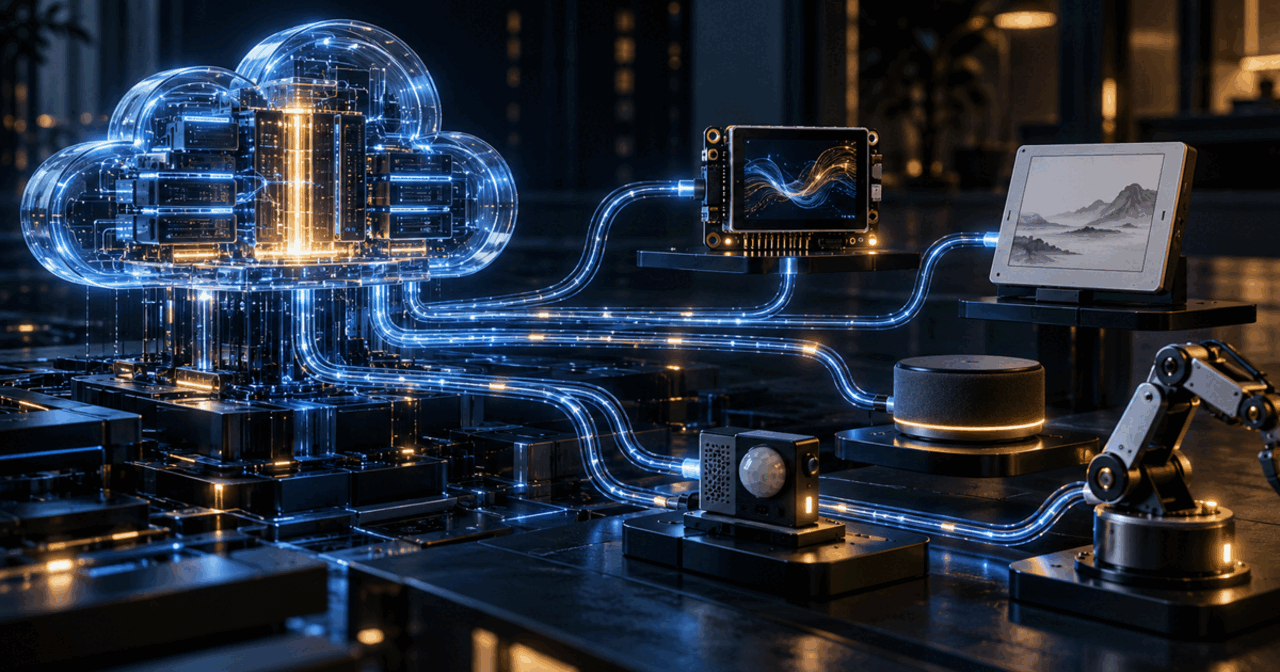
Personal AI agents are accelerating in two directions at once. In the cloud, they are becoming persistent: they retain context, work in the background, use their own computers, and return with finished work. At the same time, they are leaving the browser window. Displays, microphones, sensors, actuators, and smart-home systems are giving them interfaces to the physical world.
OpenAI's Dots, SpaceXAI's Grok Bot, and Meta's Muse Gadgets are different products. Taken together, however, they reveal a remarkably consistent architecture: the agent is becoming a persistent runtime between people, software, and their environment.
This is more than another round of chatbots. It is the beginning of a new system class.
Three Products, The Same Shift
OpenAI Dots are always-on agents powered by GPT-6 Astra. Each dot works in a protected cloud computer, uses a browser and connected apps, can track several projects in parallel, and remains reachable through ChatGPT, Slack, or Teams. Rules, app permissions, an activity view, and separate action review are intended to constrain what the agent may do autonomously.
Grok Bot similarly describes AI teammates that keep working around the clock, sign in to tools and websites, and learn routines from observed workflows. Multiple bots can work in parallel, hand tasks to one another, and share context. One technical detail matters: according to the product FAQ, a user's bots share one persistent cloud computer, including its file system, browser, and logins. The isolation boundary is per user, not per bot.
Muse Gadgets enters at another layer. Meta published an Apache-2.0-licensed SDK for ESP32 boards and Linux devices. It connects Muse to displays, buttons, audio, sensors, and actuators. A Raspberry Pi can link Muse to Home Assistant or local Linux applications, while a small e-ink display can show briefings, reminders, or shopping lists.
Dots and Grok Bot build the persistent agent. Muse gives this agent class a device bus.
The Converging Agent Architecture
Beneath the product names, nearly every vendor is assembling the same stack:
- Persistent identity: The agent has a role, a name, long-lived context, and defined responsibilities.
- Durable runtime: Work does not end when a tab closes. Jobs continue in a cloud computer or comparable sandbox.
- Tool access: Browsers, terminals, apps, APIs, and saved sign-ins turn answers into executable work.
- Memory and routines: The agent absorbs preferences, corrections, and recurring workflows.
- Orchestration: Multiple specialized agents work in parallel, delegate, and share context.
- Policy and approvals: Rules, review surfaces, and approval gates determine what may be read, prepared, or actually executed.
- Physical input and output: Microphones, displays, sensors, actuators, and smart-home systems extend the agent's reach beyond software.
The decisive move is number seven. A browser agent can change the wrong file. A physically connected agent can also switch devices, display information in a room, or react to sensor data. Tool use becomes environment use.
Muse Gadgets Is Not A Robot—And That Is Why It Matters
At first glance, Muse Gadgets looks like a hacker side project. Nat Friedman explicitly introduced it as open-source firmware and a Linux SDK. But the use of simple components is strategically important.
ESP32 boards and Raspberry Pis are cheap, widespread, and well documented. They already live inside displays, voice devices, sensors, and smart-home projects. Instead of selling a proprietary AI robot, Meta is providing a connection layer through which an agent can use existing hardware.
The result is a loosely coupled architecture:
- Muse holds goals, context, and agent logic.
- The gadget SDK translates between agent and device.
- The endpoint provides input, output, or a bounded capability.
- A pairing token binds the device to the account.
- Local code decides which commands and sensors are exposed at all.
This is closer to a hardware adapter for agents than a finished consumer device. That is precisely its strength: the physical interface becomes programmable.
The New Security Boundary Is Impact
Persistent agents already need strong controls in the cloud. Hardware adds new failure classes.
1. Sensors are untrusted input. A microphone, camera, QR code, or connected display can deliver manipulated content. Prompt injection becomes spatial.
2. Actions have real side effects. Lights and briefings are low risk. Door locks, heating, purchases, and machinery are not. Capabilities must be narrowly typed, bounded, and revocable.
3. Shared state increases blast radius. When several bots share a cloud computer, browser, and login state, the runtime needs clear namespaces, access policies, and traceable handoffs.
4. Credentials must not become agent memory. Secure sign-in flows and separate credential stores are foundational security controls, not convenience features.
5. Physical actions require recovery. A draft can often be recalled. A switched device cannot always be undone. Systems need idempotency, timeouts, safe defaults, and a manual emergency stop.
A Technical Blueprint For Physical Personal Agents
Builders should not wire agents directly to devices. A better design uses an explicit control chain:
Observation → Intent → Policy → Plan → Capability Broker → Approval → Action → Audit → Recovery
The Capability Broker is the critical layer. It describes not merely which device is reachable, but which tightly bounded operations are allowed. A thermostat, for example, should not appear as a generic shell tool. It should expose typed actions with value ranges, time limits, and a recovery path.
Every physical capability needs at least:
- unambiguous device and user identity,
- minimal read and write permissions,
- separation between proposing and executing,
- an approval model based on risk class,
- a complete event and action log,
- safe states for network, model, or device failure,
- a locally accessible way to stop and disconnect it.
This is the hardware version of least privilege. An agent should not be allowed to “control the house.” It may be allowed to dim one named lamp for a limited period—or merely suggest the change.
The Real Platform Forms Above The Products
OpenAI, SpaceXAI, and Meta differentiate through models, interfaces, ecosystems, and governance. At the architectural level, they are converging quickly: memory, a dedicated computer, apps, background work, proactive notifications, voice, tool execution, and increasingly access to the surrounding environment.
Differentiation therefore shifts away from the feature checklist. The important questions become:
- How cleanly is identity separated from authorization?
- How visible are ongoing tasks and planned actions?
- How granularly can permissions be granted and revoked?
- How auditable are agents, devices, and human approvals?
- How reliable is recovery after failure?
- Who owns the memory, routines, and connection data?
The personal agent becomes the control plane. Browsers, apps, and gadgets become its execution surfaces.
Conclusion
Personal agents are evolving from conversational partners into persistent operators. Dots and Grok Bot demonstrate the durable cloud runtime; Muse Gadgets opens a path to displays, sensors, actuators, and smart-home systems.
For builders, the message is clear: the next agent stack does not end at the browser. It needs a hardware abstraction layer, tightly bounded capabilities, secure pairing, approval gates, audit, and recovery. Otherwise, the agent may get hands—but no dependable limits.
Sources: Nat Friedman: Muse Gadgets announcement · Muse Gadgets · Muse Gadget SDK on GitHub · OpenAI: Introducing dots · OpenAI: Safety, Security and Privacy for dots · SpaceXAI: Introducing Grok Bot · Grok Bot product page