LLM Wikis: Why Agents Need Readable Memory
LangChain, Dosu, and Chroma show why agent memory needs more than vectors: human-readable wikis as an operational knowledge layer.
Agents rarely fail because they cannot generate the next sentence. They fail because they lose the working context.
They forget why a decision was made. They re-read the same Slack threads, Notion pages, or code paths again and again. They can find documents, but not the relationship between them. Over time, long-running agents run into a familiar problem: context does not only get bigger. It gets dirtier.
That is where LLM Wikis become interesting.
In a LangChain webinar on agent memory, speakers from LangChain, Dosu, and Chroma discuss how agents can build, maintain, and reuse their own knowledge. The important point is not that agents need "more memory." The point is that they need memory that remains structured, updateable, and reviewable by humans.
A Wiki Is Compiled Context
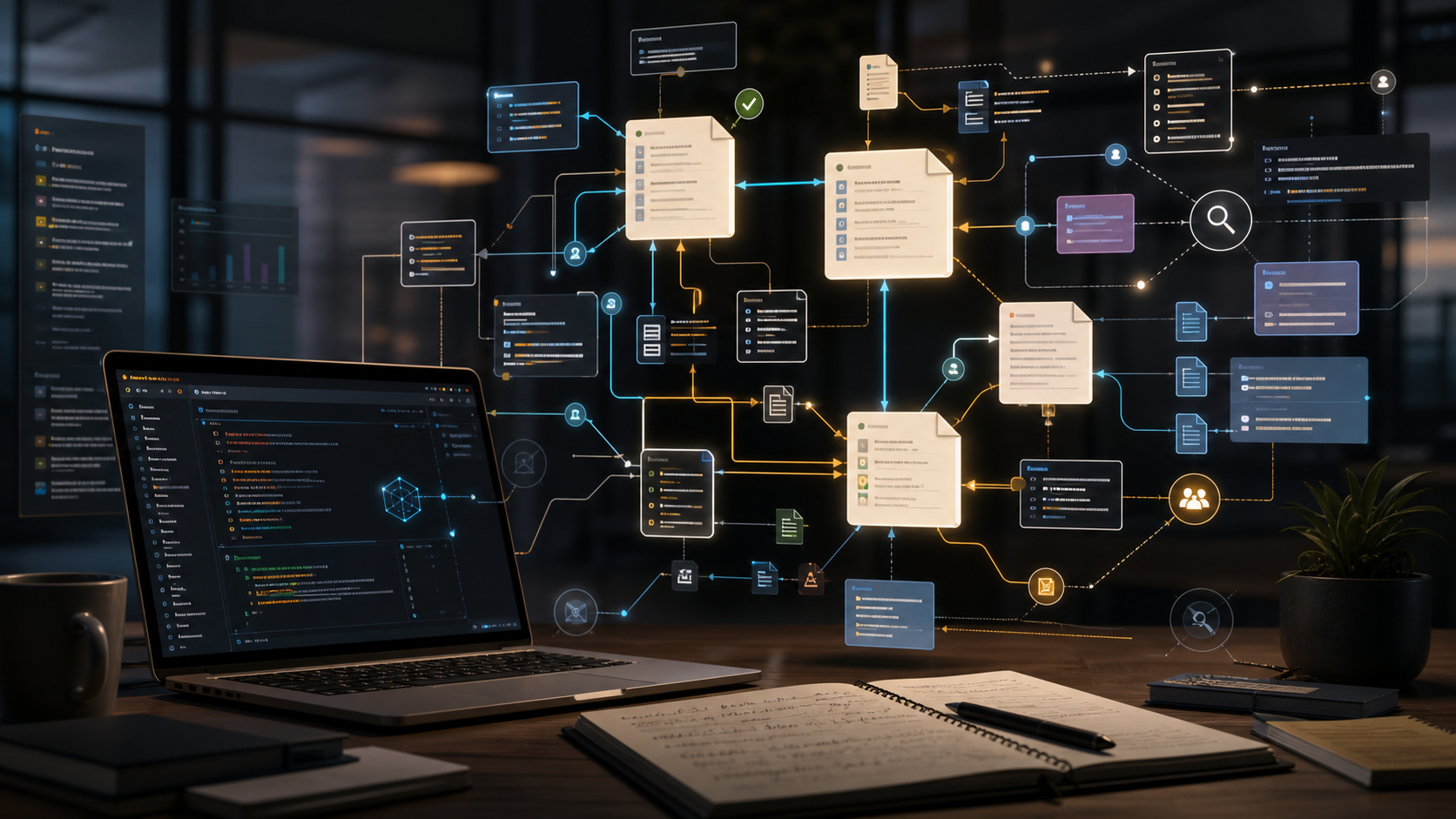
An LLM Wiki is best understood as a compiled knowledge layer. Instead of searching raw data from scratch for every task, the agent builds a set of linked pages: topics, decisions, code areas, owners, open questions, recurring workflows.
The wiki is not a nice side artifact. It is a cache for work.
A good agent should not have to rediscover the structure of a repository, the relevant Slack discussion, or an already-made product decision every time. It should store that knowledge in a form that can be retrieved, corrected, and extended.
That is the difference between retrieval and memory. Retrieval brings back material. Memory shapes meaning.
Vectors Alone Are Not Enough
Many agent systems treat memory as a vector store: ingest data, embed it, place semantic search in front of it. That is useful, but not enough.
If knowledge only lives in latent representations, humans lose control. It becomes hard to inspect what the agent believes, why it believes it, and which old information may now be wrong.
A wiki forces memory into a readable form. Not perfect, not complete, but reviewable.
That matters especially in companies. Agents are not supposed to merely answer questions. They are expected to operate in real work environments. If they act on knowledge, that knowledge should remain visible. Otherwise memory becomes a black box with confidence. Software teams already have enough of those.
Agents Need Maintenance, Not Just Storage
The hard part is not generating a page. The hard part is maintaining it correctly.
Which information is important enough to keep? What gets replaced when code or processes change? When should a page be merged, shortened, or deleted? How do you prevent agents from simply appending new paragraphs until the wiki slowly clogs itself?
The webinar points to several patterns:
- OpenWiki abstracts the creation and updating of these knowledge collections.
- Dosu works with Knowledge Indexes or Topic Pages that stay agent-friendly while remaining human-readable.
- Chroma describes wikis as a kind of road network across unstructured data, helping agents navigate messy knowledge.
The shared direction is clear: memory has to be actively maintained. Otherwise you do not get a knowledge base. You get a digital attic.
Human-Readable Is A Safety Feature
The most important idea may be this: LLM Wikis should not be optimized only for agents.
Of course they need to be token-efficient, terse, and referential. An agent does not need corporate documentation with a welcome paragraph, a mission statement, and three layers of ceremony. It needs precise orientation.
But humans still need to read it.
Human-readable memory is not nostalgia for Markdown. It is a control mechanism. When an agent updates knowledge, a human should be able to review the change like code. When the agent discovers open questions, it should ask them explicitly. When knowledge becomes stale, that should become visible.
That creates a loop: agents write and use memory, humans review and correct it, agents become more reliable.
The ag3nt.id Take
LLM Wikis show that agent memory is not a single technical component. It is an operations layer.
It connects retrieval, knowledge maintenance, human review, context compression, and tool use. If agents are going to handle longer-running tasks, they need to do more than find information. They need to learn which information deserves a place in shared working memory.
For builders, the lesson is practical:
Do not build agents with only a prompt and a vector store. Give them a readable knowledge system. One that can be searched, linked, updated, reviewed, and cleaned up when it starts to drift.
The future of useful agents will not depend only on the size of their context window.
It will depend on whether their memory remains habitable.
Source: LLM Wikis and how to give your agents memory
Further reading: What is a personal AI agent?